

Hospital warehouses are the beating heart of the healthcare supply chain, yet many operate inefficiently due to inaccurate inventories, manual processes, and poor layouts. This 21-page guide provides proven strategies to transform warehouse productivity and ensure medical supplies are accurately stocked and rapidly delivered to clinical staff.
Hospital locations served
Customer retention rate
Documented customer savings
Up to productivity gains
Supply chain spending accounts for up to 40% of total costs in healthcare systems, yet hospital warehouses often operate with inaccurate inventories, manual processes, and minimal performance monitoring. When Hurricane Maria devastated Puerto Rico in 2017, hospitals quickly ran out of IV bag inventory because they lacked proper warehouse inventory buffers and continuity planning.
Inefficient hospital warehouses create serious consequences. Delayed or missed deliveries of essential medical supplies to patient care areas result in delayed or inadequate treatment. Poor inventory management leads to excess inventory or stockouts, which increases costs and wastes resources. Expired or recalled products that aren't identified create safety issues.
Large health systems like Mayo Clinic and Cleveland Clinic carry over 100,000 distinct supplies and devices across their hospital network warehouses. This vast scope magnifies organizational and inventory management complexity.
Overall, inefficient hospital warehouses can impact both the quality of patient care and the financial health of the hospital. But improving warehouse performance provides an opportunity to reduce total supply chain costs by up to 10%.
This guide provides hospital leaders with comprehensive frameworks to optimize warehouse operations through proven strategies around warehouse design, inventory management, systems implementation, order processes, automation, and metrics tracking.
Section 1: Warehouse Optimization Strategies & Strategic Role Understand why hospital warehouses provide an indispensable support structure enabling quality care. Learn how efficient warehouses support patient care by providing clinical team confidence they can securely access required supplies for surgeries, treatments, and everyday requests. Discover how warehouses manage the vital link between external transportation and internal hospital distribution while balancing sufficient inventory without excessive waste.
Section 2: Common Hospital Warehouse Challenges Identify the unique difficulties hospital warehouses face that don't exist in other industries. Address high product variety (managing thousands of medical products from routine supplies to specialty implants), regulatory compliance (FDA, DEA, OSHA, EPA requirements), urgent requests (unpredictable clinician demands requiring rapid fulfillment), space constraints (expensive clinical facilities with limited expansion options), budget limitations (tight hospital budgets restricting technology investments), controlled substances and hazards (stringent security protocols), and multi-facility coordination (health systems coordinating centralized operations across multiple locations).
Section 3: Optimizing Warehouse Layouts Design efficient warehouse layouts that logically align inventory, operations, infrastructure, and workflows to maximize productivity. Implement zoning and slotting strategies that divide space for faster-moving, hazardous, refrigerated, and bulky items. Optimize aisle design for material handling flexibility. Maximize vertical space utilization with taller racks and multi-level pick modules. Standardize storage with consistent shelving units and bin sizes. Control temperature zones with monitoring systems for pharmaceuticals and specimens. Isolate hazardous materials with proper ventilation and containment. Enable rapid order staging by pre-picking faster-moving supplies like OR kits near shipping areas.
Section 4: Systems, Inventory, Ordering, and Picking Excellence Implement warehouse management systems (WMS) that deliver real-time inventory tracking, digital order management, integrated putaway and picking logic, radio-frequency and barcode scanning, labor monitoring, and performance analytics. Strengthen inventory management through centralized master data, standardized product IDs, system-directed putaway, and cycle count schedules (Class A monthly, Class B quarterly, Class C semi-annually). Streamline ordering and receiving with data-based replenishment rules, consolidated purchase orders, regular receiving appointments, automated advance ship notices, staged receiving areas, putaway prioritization using FEFO logic, and vendor scorecard metrics. Orchestrate efficient picking through engineered batch picking, designated picking zones, velocity slotting, and par level replenishment cycles.
Section 5: Automation and Performance Monitoring Leverage warehouse automation including mobile robots (reduce picker travel time), automated storage and retrieval systems or ASRS (maximize storage density and speed, with ROI typically within 2-3 years despite $2-5M upfront cost generating $8M+ labor savings over five years), pick-to-light systems (visual picking direction boosting accuracy), conveyors and sorters (streamline fulfillment workflows), and BlueQ SmartScan (handheld device with route control, proof of delivery, cycle counting, and barcode scanning). Monitor performance with key performance indicators including perfect order percentage, inventory accuracy, stockout percentage, inventory turns, fill rate, picks per hour/FTE, labor utilization rate, and receiving/putaway time. Use BlueQ Analytics for spend and volume reports, pars management, predictive reports for out-of-stock and surplus, huddle boards, labor/time management dashboards, and data-driven bin sizing and spend management.
Reading the guide provides the optimization frameworks. Partnering with BlueBin provides the proven technology and expertise that ensures successful implementation.

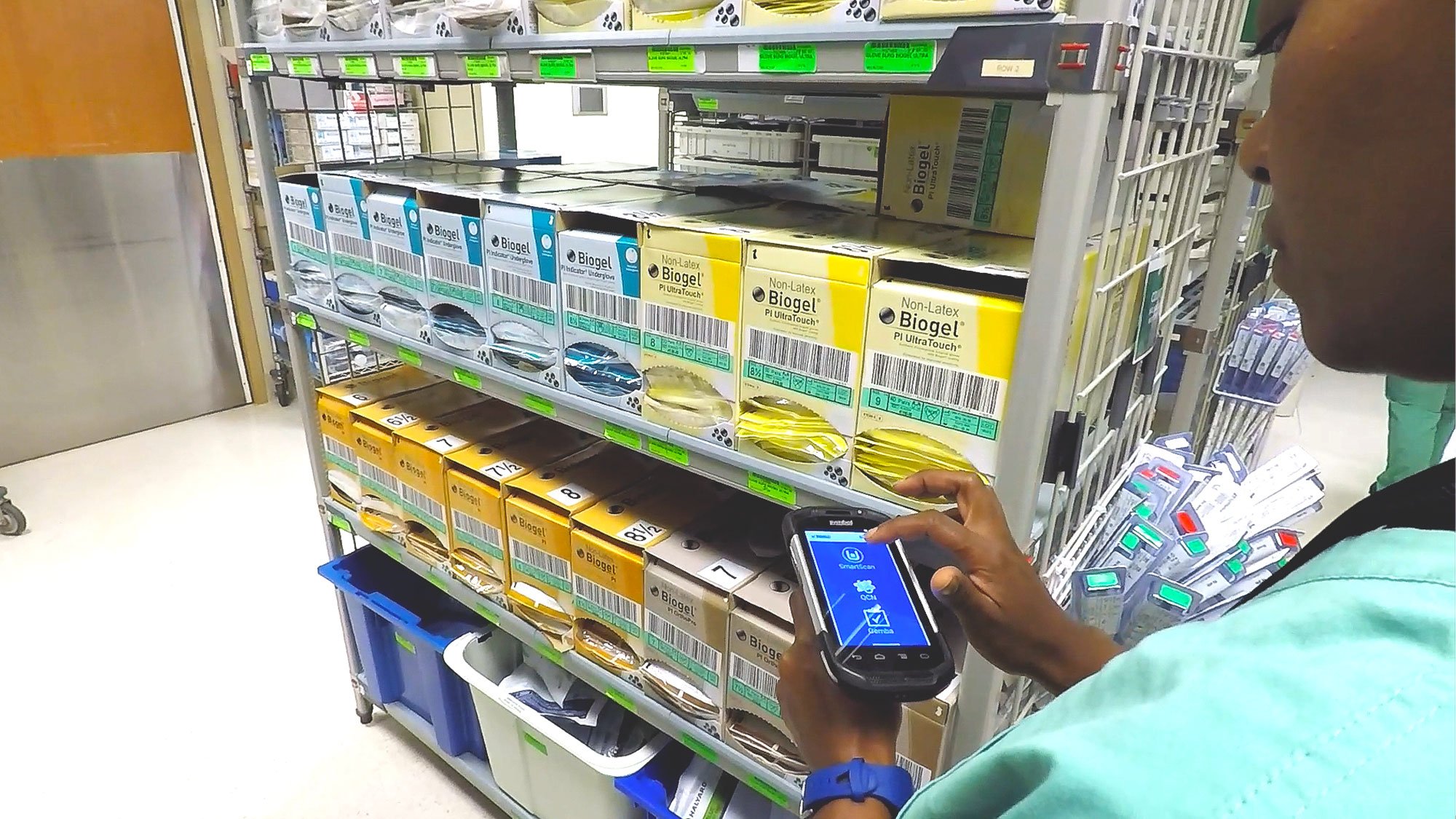
Optimize warehouse efficiency through robust route control, proof of delivery, cycle counting, and barcode scanning capabilities. This handheld device consolidates tasks, reduces paperwork, and enables real-time inventory tracking from receiving to warehouse management to procedural access.

Gain comprehensive visibility into warehouse performance with spend and volume reports, pars management, predictive out-of-stock and surplus alerts, huddle boards, labor/time management dashboards, and data-driven bin sizing. Access critical information from multiple devices to make informed decisions in real-time.

Leverage BlueBin's expertise implementing warehouse optimizations across 300+ hospital locations. Our team provides layout design guidance, WMS implementation support, automation strategy development, and ongoing performance monitoring to ensure your warehouse transformation delivers measurable results.
Hospital warehouses contend with seven unique challenges. First, high product variety: managing thousands of medical products from routine supplies to specialty implants and devices, with large systems like Mayo Clinic and Cleveland Clinic carrying over 100,000 distinct items. Second, regulatory compliance: adhering to FDA, DEA, OSHA, and EPA requirements for pharmaceuticals, controlled substances, and hazardous chemotherapy agents. Third, urgent unpredictable requests: clinicians need rapid fulfillment for emergency procedures and critical diagnostics, requiring safety stock and streamlined processes. Fourth, space constraints: warehouses are often located in expensive clinical facilities with limited expansion options. Fifth, budget limitations: tight hospital budgets restrict capital investments in technology and staffing. Sixth, controlled substances and hazards: stringent security protocols and handling procedures for drugs and dangerous materials. Seventh, multi-facility coordination: health systems must coordinate centralized warehouse operations across multiple hospitals and clinics, meeting each site's unique needs.
Warehouse layout optimization involves seven key elements. Zoning and slotting strategies divide space for faster-moving, hazardous, refrigerated, and bulky items, slotting high-velocity products near pick/pack zones. Aisle design uses wider aisles for material handling flexibility and angled aisles for directional traffic in high-density areas. Vertical space utilization maximizes height with taller racks and multi-level pick modules. Storage standardization uses consistent shelving units and bin sizes so workers learn item "homes" faster. Temperature zone control maintains quarantined zones with monitoring systems for refrigerated pharmaceuticals and specimens. Hazardous material isolation uses restricted zones with proper ventilation and containment. Rapid order staging pre-picks faster-moving supplies like OR kits near shipping areas for urgent fulfillment. While layout changes involve initial disruption, the process typically takes 4-8 weeks for a comprehensive redesign. Optimized design aligns inventory with clinical workflows to make fulfillment smooth and efficient, often reducing picker travel distance by 30-40%.
A WMS delivers six core capabilities: real-time inventory tracking and visibility, digital order/task management and workflow direction, integrated putaway/expiration date/picking logic and replenishment, radiofrequency and barcode scanning integration, labor monitoring and equipment tracking, and performance analytics and dashboards. By digitizing paper-based processes, a WMS boosts productivity by up to 30% and accuracy over manual approaches. Additional benefits include reduced stockouts and expires through sophisticated expiry tracking and cycle counting, regulatory compliance via lot tracking and recall reporting, faster fulfillment through digital order transmission and batch picking, and enhanced labor productivity through task automation and workflows that maximize worker time and minimize errors. Before selecting a WMS, hospitals should assess current workflows, inventory profiles, interface requirements, and desired reporting. User training and buy-in are critical to maximize benefits. Integrating a WMS with hospital ERP and clinical IT systems synchronizes essential inventory data to support patient care. ROI is typically achievable within 2-3 years.
Five automation technologies deliver strong ROI. Mobile robots (autonomous units that transport loaded carts through picking zones and warehouse areas) reduce unproductive picker travel time. Automated Storage and Retrieval Systems (ASRS) use computerized cranes to store and retrieve inventory from densely packed racks, maximizing storage density and speed. An ASRS system for a large hospital warehouse can cost $2-5 million upfront but generate over $8 million in labor savings over five years, with ROI typically within 2-3 years. Pick-to-light systems use light-directed picking indicators at shelving bays to improve accuracy and productivity, with lights switching off when picks are complete. Conveyors and sorters transport and intelligently divert items through the warehouse to consolidation zones, streamlining fulfillment workflows. BlueQ SmartScan provides a handheld device optimizing warehouse efficiency through route control, proof of delivery, cycle counting, and barcode scanning, consolidating tasks, reducing paperwork, and enabling real-time inventory tracking. While upfront investment can be substantial, long-term benefits outweigh costs through labor savings and scalability, with ROI typically achievable within 2-3 years.
Five strategies strengthen inventory management. First, centralized master data: consolidate item details like pricing, dimensions, storage requirements, and replenishment parameters into a single database source to improve reporting accuracy, following retail leaders like Walmart with mature item master data management. Second, standardized product IDs: apply unique SKU identifiers and barcodes to all inventory to simplify tracking across WMS and hospital systems, avoiding confusion. Third, system-directed putaway: scan item labels and bin locations during putaway to maintain system inventory accuracy, with visual cues helping workers identify new stock awaiting putaway. Fourth, cycle count schedules: conduct frequent cycle counts focused first on high-value and fast-moving items to minimize large disruptive physical inventories. Use Class A (mission-critical and high-cost items) monthly, Class B (medium cost and volume) quarterly, and Class C (low cost and volume) semi-annually. Adjust WMS on-hand balances after each count. Fifth, key performance indicators: analyze trends in inventory accuracy, stockout rates, velocity, item turns, and days on hand to gain insights into required policy adjustments.
Six practices streamline ordering and receiving. Data-based replenishment rules set par levels and reorder points based on historical usage and trends instead of gut feel, integrating signals from Materials Management, ERP, and clinical systems. Consolidated purchase orders group orders into a single weekly PO per vendor for volume discounts instead of urgent one-offs. Regular receiving appointments agree with vendors on consistent delivery windows (e.g., every Tuesday 9-11 AM) to ease scheduling and upstream planning. Automated advance ship notices (ASNs) require ASNs from vendors to provide shipment visibility before goods arrive to prevent surprises. Staged receiving areas use well-defined processing zones with adequate space, equipment, and standard operating procedures to improve speed and accuracy as inventory arrives. Putaway prioritization ensures prompt putaway of received goods into the WMS to preserve system inventory accuracy, leveraging first-expire-first-out (FEFO) logic to optimize shelf life management. Vendor scorecard metrics track on-time delivery rate, order accuracy, responsiveness, peak delivery capacity, compliance with ASNs, returns processing, and invoice accuracy to score and monitor vendor performance.
Four strategies optimize picking and replenishment. Engineered batch picking groups orders requiring similar items into batches to reduce picker travel distance and improve speed, batching urgent requests separately. Potential criteria include by hospital department or nursing unit, by supply type (pharma, devices, perioperative, etc.), by storage zone/area, by urgency level, and by date required. Designated picking zones restrict actively picked items into segmented pick zones (Zone 1: high-volume medical-surgical supplies, Zone 2: pharmaceuticals and refrigerated items, Zone 3: orthopedic and cardiac devices/implants, Zone 4: OR kits and anesthesia supplies, Zone 5: laboratory reagents and specimens) designed based on activity level, security, refrigeration, and material handling requirements to simplify replenishment workflows and improve picker productivity. Velocity slotting assigns fastest-moving items to hip- and eye-level slots to optimize ergonomics and minimize picker fatigue, with heavier items on lower shelves. Par level replenishment cycles define minimum and maximum quantities for each primary pick location, triggering replenishment when floor stock hits predefined minimums based on historical velocity. Technologies like pick-to-light systems provide visual picking direction to boost accuracy.
Track eight essential KPIs: perfect order percentage (orders filled accurately), inventory accuracy (cycle counting variance), stockout percentage (line items out of stock), inventory turns (usage velocity), fill rate (orders picked on time), picks per hour/FTE, labor utilization rate, and receiving and putaway time. Comparing KPI trends to external benchmarks and hospital supply chain goals enables fact-based management. Daily or weekly reviews allow managers to make agile course corrections. BlueQ Analytics is a leader in healthcare inventory solutions providing an efficient, reliable, and robust analytics system. BlueQ Analytics gives you access to spend and volume reports, pars management reports, accessibility from multiple devices, stock/bin rotation metrics, predictive reports for out-of-stock and surplus, huddle boards, labor/time management dashboards, data bin sizing, and data spend management. Analytics streamline the process from your manufacturer down to when someone pulls inventory from supply bins.
3 Tips to Better Hospital Warehouse Management
Our top three tips to improve your warehouse management through technology, organization, and proper training.