Your Supply Chain Is Costing You $4 Million a Year That Never Appears on an Invoice

A CFO's framework for sizing the opportunity, building the business case, and evaluating every approach competing for the capital. 

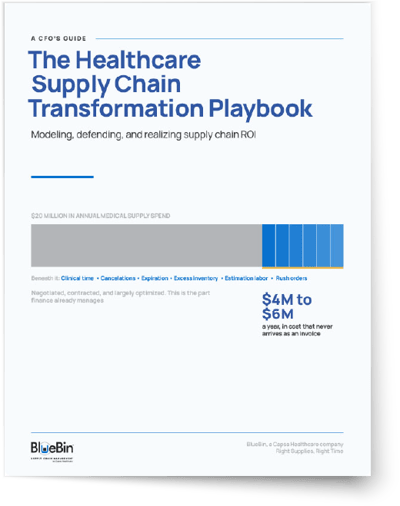
The purchase price is part of the supply cost that your team already manages closely. The money that is left sits underneath it: clinical time spent hunting supplies, inventory that expires on the shelf, working capital tied up as insurance against stockouts, and rush orders that quietly undo your contract savings. For a 400-bed hospital with $20 million in annual supply spend, that burden typically runs $4 million to $6 million a year.

This guide gives you the tools to quantify it yourself. Four financial formulas with a blank worksheet, a month-by-month view of when returns actually reach the P&L, the four commitments worth writing into any contract, and twelve questions to ask any partner before you sign, including us.

A CFO's Guide: The Healthcare Supply Chain Transformation Playbook

What's inside the guide

This guide gives finance and supply chain leaders a practical framework for modeling the opportunity before they talk to any vendor.

  • The six categories of hidden cost that sit beneath purchase price, and how to size each one from data your team already has
  • A four-part financial model with a blank worksheet your finance and supply chain teams can complete together
  • A clear view of the sequence behind supply chain transformation: process first, capability second, technology third
  • An honest comparison of options, including where a two-bin Kanban system fits and where high-capital approaches underdeliver against a CFO's timeline
  • Documented program economics from federal, academic, community, and pediatric health systems, with projections separated from results
  • Twelve questions to ask any partner, plus a readiness checklist to complete before an assessment begins

Get the Guide

Instant download. No sales call required to read it.

We will email you the download link and occasional supply chain research. Unsubscribe any time.

Why This Matters Now


Unnecessary hospital supply chain spending runs approximately $25.7 billion a year in the United States, an average of $12.1 million per hospital, measured as the gap between typical and top-quartile performance across 2,127 hospitals. Meanwhile, the most commonly proposed improvement approaches take two to three years to produce a sustainable system, or require committing capital upfront against savings that arrive later. Neither profile survives a difficult budget cycle.

The organizations closing that gap are sequencing differently: process first, capability second, technology third. This guide explains the economics of that sequence and gives you the means to test it against your own numbers.
What this guide documents


Walter Reed Military Medical Center

BlueBin’s two-bin Kanban system helped this flagship military medical center cut supply function staffing 79%, return 40% of clinicians’ time to patient care, and recover $5.2M in excess inventory.

  • $5.2 million in excess inventory recovered
  • $2.36 million in total program cost
  • 79% reduction in supply function staffing
  • Expired product reduced from $71,636 to zero

Documented program economics

A multi-facility health system documented 3.4x ROI with payback in under a year at its pilot operating room facility, while eliminating $498,000 a year in legacy cabinet lease costs.

In April 2026, Black Book Research ranked BlueBin the number one client-rated vendor in Inventory, Warehouse, Point-of-Use and Replenishment Automation, based on surveys of 1,335 supply chain professionals across 1,019 provider organizations.

Who should read this guide


This guide is written for healthcare leaders who need a financial case that stands up under budget pressure.

  • CFOs and finance leaders evaluating capital allocation, payback timing, and total program cost
  • Supply chain vice presidents and directors building the case for a transformation that produces measurable results in 9–15 months
  • COOs and operations leaders responsible for throughput, labor efficiency, and sustainable performance across facilities
  • Clinical leaders who need to understand how supply chain discipline returns time to patient care

Frequently asked questions


Model four benefit streams separately. Recurring supply expense savings are annual medical supply spend multiplied by 3 percent for a conservative case or 7 percent for an aggressive one. One-time working capital released is the current inventory value multiplied by 20-25 percent. Clinical capacity is nursing FTEs multiplied by 250 shifts, 0.5 hours per shift, and the average hourly cost. Materials management capacity is supply chain FTEs multiplied by a 30 percent efficiency gain and fully loaded cost. Present the first two as cash and the last two as capacity released, and calculate any ROI multiple against the total program cost rather than against one component of it.

Six categories sit beneath purchase price: clinical time spent hunting for and staging supplies; procedure delays and cancellations caused by stockouts; product expiration; excess inventory carrying costs; materials management labor spent estimating and counting rather than analyzing; and rush-order premiums that fall outside group purchasing contracts. Together, they typically equal 20 to 30 percent of total supply spend, which is $4 million to $6 million a year for a hospital with $20 million in annual supply spend.

A process-first replenishment transformation reaches full deployment in 9 to 15 months, with cash results typically appearing in months 6 to 12. By comparison, building a sustainable in-house Lean management system across a health system generally takes two to three years, and deploying automated dispensing cabinets takes the same amount of time due to capital constraints and installation complexity.

BlueBin sustains a 98 percent overall fill rate, and documented program performance runs higher. Fill rate should always be measured at the point of use rather than at the warehouse: a fill rate measured at the dock tells you nothing about whether the clinician found the item on the shelf. Note that fill rate and bin-fill accuracy are different metrics and are not interchangeable.

Yes. Two-bin Kanban maintains full ERP compatibility and stabilizes supply chain operations during a migration rather than competing with it. Many organizations use the implementation as an opportunity to clean up item masters and standardize processes before moving to a new platform. Montage Health migrated from Lawson to Workday without relabeling a single bin.

Related Resources for CFOs


Keep exploring