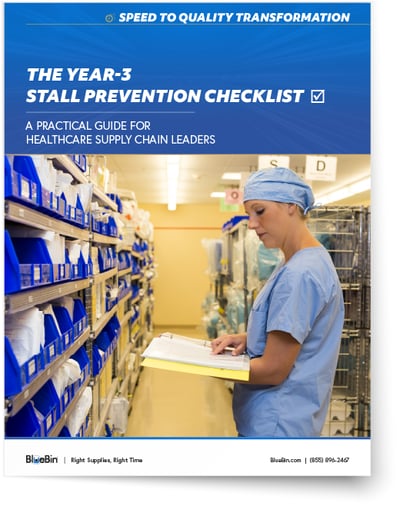
AHRQ research documents that most hospital lean programs stall by year three. This free checklist helps supply chain leaders identify warning signs early, assess structural risk, and take corrective action before momentum fades.
What's Inside:
Trusted by 300+ hospitals. $845M in documented customer savings. 98% customer retention.
Download instantly
Not ready to download?
Read the full article: Why Hospital Lean Programs Stall — and How to Prevent It
Hospital locations served
Customer retention rate
Documented customer savings
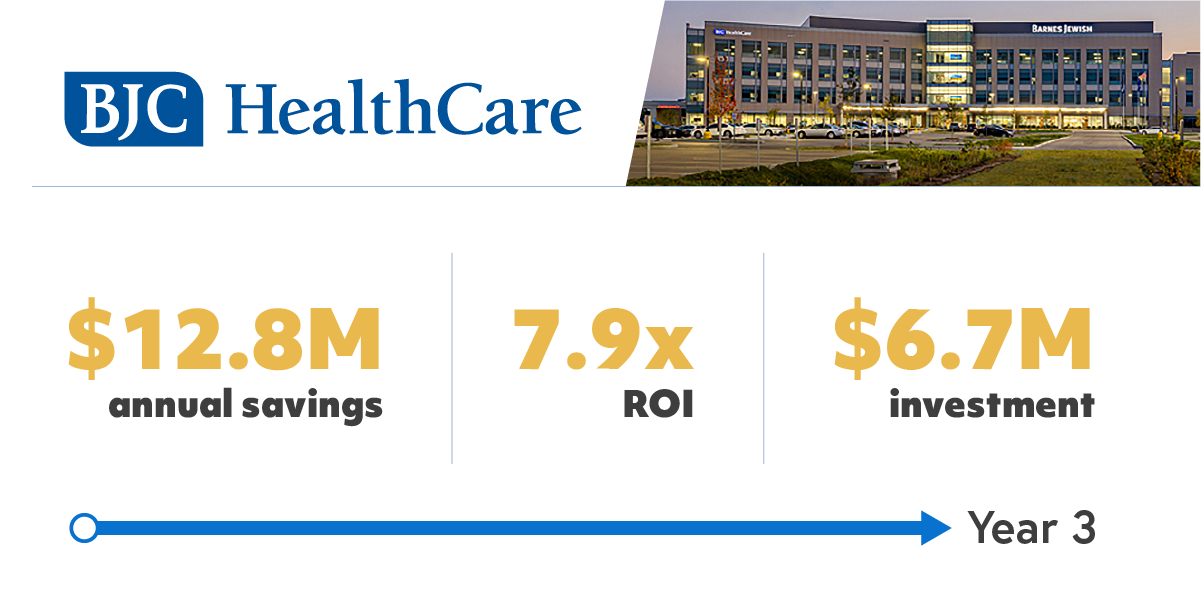
ROI — BJC HealthCare
The pattern is well-documented. A hospital supply chain lean program launches with executive support and early wins. Year one delivers pilot results. Year two expands implementation. Then, in year three, momentum stalls — champions move on, staff revert to old habits, and leadership questions whether to keep investing.
AHRQ research confirms this isn't a commitment problem. It's a structural one. Most lean programs transfer knowledge without building genuine capability, create champion dependency without systematic accountability, and declare success before sustainability is proven.
The cost is significant. Organizations that stall typically spend $5-7 million in years one and two, only to plateau at break-even returns — while organizations that get it right generate 7-9x ROI over five years. That gap is preventable.
1. Knowledge Without Capability Transfer — Staff learn lean principles but never develop the hands-on expertise to sustain results independently.
2. Champion Dependency — Programs built on individual heroics collapse when key people change roles, burn out, or move on.
3. Consultant Departure Without Replacement — External expertise walks out the door before internal capability is fully developed.
4. Competing Priorities and Budget Pressure — By year three, the lean program loses executive attention to newer initiatives.
5. Exhaustion from Split Responsibilities — Staff can't sustain transformation while managing their regular workloads indefinitely.
6. No Continuous Improvement Mechanism — Initial gains plateau when there's no systematic process to keep optimizing.
This isn't a generic lean program evaluation. It's a structured assessment tool built around the specific structural causes AHRQ research identifies in hospital lean programs. Complete it in under 30 minutes and walk away with a clear picture of where your program is most vulnerable.

Quickly and efficiently build the materials you need to support your inbound marketing strategy. Drag and drop building blocks including testimonials, forms, calls-to-action, and more.

36 specific checkpoints organized by prevention area. Work through each to identify which structural protections are already in place and which need attention.

32 early warning indicators organized into four categories. Review quarterly to catch momentum loss before it becomes a stall.
Step-by-step guide for launching new lean initiatives with sustainability built in from day one — not bolted on after problems emerge.

25 criteria to verify before transitioning external support out of your organization. Covers performance, capability, system, and organizational readiness.

"By year three, when traditional programs typically stall, BJC HealthCare was generating $12.8 million in sustained annual savings — and continuing to improve."
BJC HealthCare System-Wide Transformation | 36-Month BlueBin Program
Real-time dashboards, supply room heat maps, and predictive ML alerts provide 5-7 weeks of advance warning on supply disruptions. Problems surface before they become stalls.

Tiered daily huddle boards create systematic accountability at every level of the organization — so performance doesn't depend on individual champions who may eventually move on.
Supply chain directors, VPs of materials management, COOs, and CNOs at hospitals and health systems who are currently managing a lean supply chain transformation or evaluating one. It's most valuable for programs in years one through three, but also useful for organizations considering whether to recommit to or sunset a stalled program.
No — and that's the point. The most effective time to use this checklist is before warning signs appear. The structural vulnerabilities that cause year-3 stalls are usually present from the beginning; they just don't become visible until momentum fades. Using this checklist in year one or two gives you time to address issues while it's still relatively easy to do so.
The full checklist takes 20-30 minutes to complete individually. If you complete it as a team — which we recommend for the Risk Assessment section — set aside 60-90 minutes for discussion.
The checklist includes a section on recommended actions by risk level, including specific guidance for programs showing critical warning signs. In short: acknowledge it, assess the structural causes, and decide whether to recommit with proper structure or sunset the program honestly. Continuing to invest without addressing root causes wastes resources and creates organizational cynicism that makes future improvement harder.
Standard consulting engagements transfer knowledge and then depart. BlueBin's turnkey model is explicitly designed to prevent the year-3 stall — through BlueBelt certification that builds internal capability, a Daily Management System that creates accountability independent of individual champions, and BlueQ Analytics that enable continuous improvement long after external support transitions out. We don't declare success at go-live. We prove sustainability before we leave.
The full context behind AHRQ's lean program research is covered in our blog post, Why Hospital Lean Programs Stall — and How to Prevent It. The checklist sections are structured directly around the structural failure modes AHRQ documents.