Most hospital replenishment systems waste clinical time, create stockouts, and drive up costs because they were designed for efficiency rather than clinical workflow. This 23-page guide walks you through implementing point-of-use systems that eliminate reordering guesswork, reduce waste, and free nurses to focus on patient care.
Hospital locations served
Customer retention rate
Documented customer savings
ROI — BJC HealthCare
Hospital supply replenishment directly impacts patient care quality, yet most organizations rely on methods that create more problems than they solve. Traditional PAR cart systems require constant manual counting. Periodic automatic replenishment ignores actual usage patterns. And automated dispensing cabinets lock critical supplies behind expensive technology barriers.
The result? These systems waste clinical time as nurses spend 20-30% of their shift hunting for supplies. Stockouts delay procedures. Overstocking ties up capital in expired inventory. And supply chain managers constantly fight fires instead of optimizing performance.
The core issue isn't the products being managed. It's that replenishment methods weren't designed around clinical workflows. They were designed around warehouse efficiency.
This guide provides the frameworks, implementation roadmaps, and decision criteria you need to transform hospital supply replenishment from a constant challenge into a reliable competitive advantage.
Chapter 1: Understanding the Clinical Perspective
Partner with stakeholders across departments to analyze consumption patterns and tailor systems to actual needs. Learn how to involve nurses, physicians, and department managers in design decisions that affect their daily workflows.
Chapter 2: The Power of Point-of-Use Systems
Implement Kanban methods using two-bin systems and electronic PAR-level indicators that eliminate reordering guesswork. Discover how visual management reduces stockouts, prevents overstock, and frees clinical staff from inventory management tasks.
Chapter 3: Automation and Technology Integration
Leverage RFID tracking for near-perfect inventory accuracy without manual counting. Explore AI-driven predictive analytics that analyze historical data and usage patterns to optimize order quantities and anticipate shortages. Understand when barcode scanning prevents mix-ups and verifies correct products in correct locations.
Chapter 4: Data Management and Visibility
Achieve clean data through regular cleansing, proper item categorization, and substitution management. Gain real-time supply flow visibility with tools like BlueQ Analytics that track inventory levels, monitor usage patterns, and identify bottlenecks by department.
Chapter 5: The External Supply Chain
Optimize your external supply chain through primary distributors (single vendor relationships with competitive pricing), consolidated service centers (bulk purchasing with economies of scale), or hybrid models that combine both approaches for maximum flexibility.
Chapter 6: Efficiency, Sustainability, and Cost Savings
Discover how automated supply systems reduce inventory management time by up to 60%, freeing hundreds of clinical staff hours monthly. Learn sustainability strategies supported by Practice Greenhealth data: 78% of healthcare professionals say sustainability initiatives protect staff, 69% say they make business sense, and 60% say they're important when choosing a hospital.
Chapter 7: Regulatory Compliance
Improve tracking, documentation, and audit trails to reduce regulatory penalties. Learn how point-of-use systems provide complete audit trails from receipt to usage, support FDA and Joint Commission compliance, and enable automated flagging of expired or soon-to-expire items.
Chapter 8: Scalability and Implementation
Start with pilot programs in single departments like the ED, then expand gradually using modular systems. Leverage cloud-based solutions for scalability across your entire health system without massive upfront infrastructure investments.
Chapter 9: Staff Training and Empowerment
Build lasting capability through comprehensive onboarding, refresher courses, and BlueBelt Certification programs that train internal experts in building Kanban nodes, managing PAR levels, conducting gemba audits, leading continuous improvement, and analyzing dashboards.
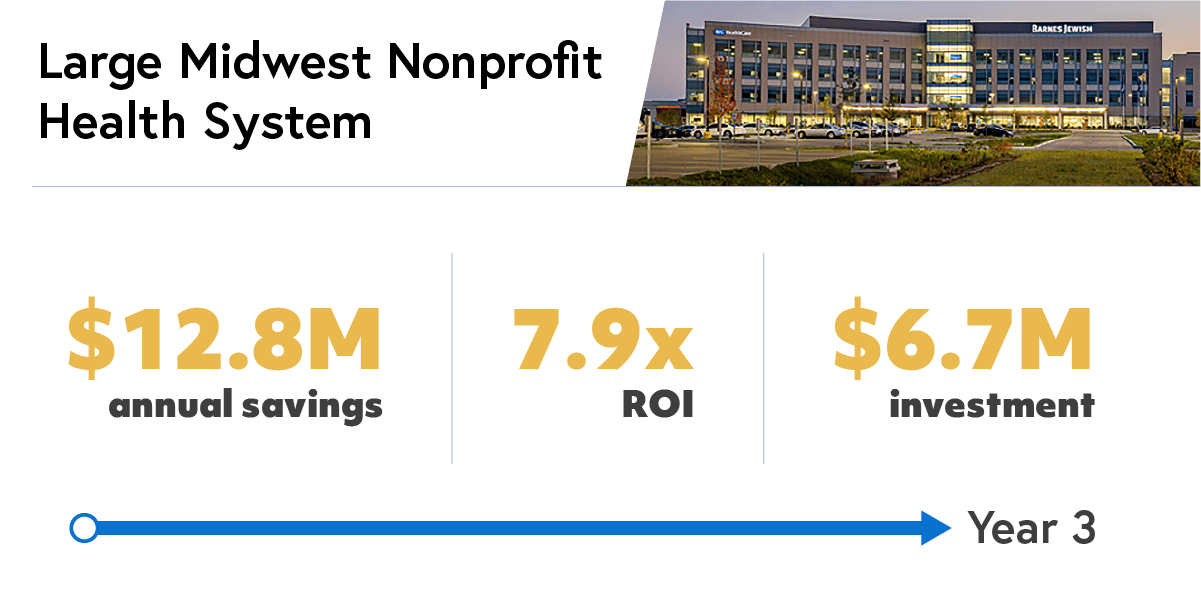
BJC Healthcare, one of the largest nonprofit health systems in the United States, implemented BlueBin's point-of-use replenishment system across their network. The results transformed their supply chain performance:
See the BJC HealthCare case Study
"The visual management system eliminated the guesswork. Our nurses immediately knew when supplies needed reordering, and they trusted that items would be there when needed. That trust transformed our entire operation."
– BJC Healthcare Supply Chain Leadership
Reading the guide gives you the frameworks and decision criteria. Partnering with BlueBin gives you the proven implementation support that ensures success.

oint-of-use Kanban systems use visual management (typically two-bin systems) where one bin in use automatically signals reorder of the backup bin. This eliminates manual counting required by PAR carts and the cost barriers of automated cabinets. Traditional PAR carts require nurses to count inventory and manually order, wasting clinical time. Automated dispensing cabinets solve the counting problem but cost $40,000-$100,000+ per unit and still require manual restocking. Kanban systems deliver the efficiency of automation at a fraction of the cost, with the added benefit that anyone can see supply status at a glance without opening cabinets or accessing software.
Start with a pilot program in a single department (typically the ED due to high volume and variety). Pilot implementation takes 4-6 weeks including staff training. Once the pilot proves successful, expansion to additional departments occurs in 2-3 week increments per area. A full hospital implementation typically completes in 9-15 months. Required resources include a project champion (typically Materials Management Director or Supply Chain Manager dedicating 25-30% time during implementation), frontline staff participation in initial setup (2-4 hours per department), and ongoing BlueBelt Certification training (40 hours over 3 months for internal experts). Unlike technology-heavy solutions, Kanban doesn't require IT infrastructure upgrades or extensive system integration.
Typical ROI ranges from 3x to 7x within the first year, with documented cases like BJC Healthcare achieving 7.9x ROI ($12.8M annual savings). Financial benefits come from five sources: reduced inventory carrying costs (20-35% reduction in on-hand inventory value), eliminated waste from expiration (15-25% reduction in expired product write-offs), recovered clinical labor (nurses reclaim 20-30% of time previously spent on supply tasks), improved fill rates reducing emergency orders (99.9% fill rates eliminate expensive rush shipping), and supply expense reduction (5-7% decrease through better visibility and usage tracking). Most organizations achieve full payback within 6-12 months.
No. While RFID tracking and AI predictive analytics offer additional capabilities, they're not prerequisites for transformation. The guide covers the full spectrum from simple visual management (two-bin Kanban) to advanced automation so you can match technology to your specific needs and budget. Many hospitals achieve 99.9% fill rates and recover hundreds of clinical hours using basic Kanban systems without any RFID or AI investment. The key is implementing the right process first. Technology should enhance a working process, not substitute for one. Start with visual management and data visibility through tools like BlueQ Analytics (which works with your existing ERP system). Add RFID or AI later if specific use cases justify the investment, such as tracking high-value implants or managing complex pharmaceutical refrigeration.
The guide covers three external supply chain models: primary distributors (single vendor relationships offering competitive pricing and simplified ordering), consolidated service centers or CSCs (bulk purchasing with economies of scale, typically serving multi-hospital systems), and hybrid models combining both for maximum flexibility. Most successful implementations use hybrid approaches: CSCs for high-volume commodity items where bulk purchasing drives savings, and primary distributors for specialty items, time-sensitive supplies, and products requiring specific handling. The key is aligning your internal point-of-use systems with external supply chain capabilities so replenishment triggers automatically flow to the right supplier based on product type, volume, and urgency. This eliminates the manual coordination that creates delays and stockouts.
Point-of-use systems actually improve regulatory compliance compared to traditional approaches. The guide details how these systems provide complete audit trails from receipt to usage, support FDA and Joint Commission requirements, and enable automated tracking of expiration dates. When implemented properly with tools like BlueQ Analytics, you gain real-time visibility into lot numbers, expiration dates, and usage patterns by location. This supports recall management, ensures first-expired-first-out rotation, and provides documentation for regulatory audits. The system also flags expired or soon-to-expire items automatically, reducing compliance risk compared to manual checking. For controlled substances requiring DEA compliance, the visual management approach makes it immediately obvious when items are missing and provides clear chain-of-custody documentation.
Yes. BlueBin's approach is specifically designed to work with existing ERP systems (Epic, Lawson, Oracle, SAP, Workday, etc.) rather than requiring replacement. Point-of-use Kanban systems handle the physical replenishment workflow while BlueQ Analytics integrates with your ERP to provide real-time visibility and consumption tracking. This means you keep your existing technology investments while adding the visual management and clinical workflow optimization that ERPs don't provide. The guide includes specific guidance on data integration, clean item master data management, and how to leverage ERP data for demand forecasting without getting trapped in manual data exports and spreadsheet analysis.
Sustainability requires three elements covered in the guide: BlueBelt Certification training to build internal expertise (so you're not dependent on external consultants), visual management that makes problems immediately obvious (making it easy to spot and fix issues before they cascade), and simple daily management systems including gemba audits and huddle boards. Most successful organizations dedicate 2-3 BlueBelt-certified staff members who spend 15-20% of their time on ongoing system optimization. This is far less resource-intensive than traditional approaches because the visual nature of Kanban makes it self-managing at the frontline level. Problems surface quickly and get resolved before requiring management intervention.
Why Hospital Lean Programs Fail — and How to Prevent It